As cross-border trade grows, so does the compliance burden that comes with it. Every country has its own customs rules, tax regime and documentation requirements — and those rules keep changing. Tracking them by hand is not only slow in 2026 but increasingly risky. A single document error can hold a shipment at the border for days; a single non-compliance can bring a penalty. In cross-border logistics, compliance is no longer a back-office task but a risk-management issue at the center of the operation.
Where compliance breaks when managed by hand
Manual compliance processes break at four typical points:
- Document error: A wrong or missing customs document holds the shipment at the border. Every day of delay is both cost and lost customer trust.
- Country-specific invoicing: Each market's legal invoice requirements differ; a manual process inevitably produces errors.
- Expiring permits: Vehicle and driver document expiry dates get missed when tracked by hand — until an inspection surfaces the problem.
- Changing regulation: When rules change, manual processes adapt late; that lag is a direct penalty risk.
Compliance moves into the software
The new standard in 2026 takes compliance out of being an after-the-fact check and places it inside the flow. The difference is subtle but fundamental: instead of checking compliance after the shipment leaves, apply it as the shipment is created. In Speetta, that means:
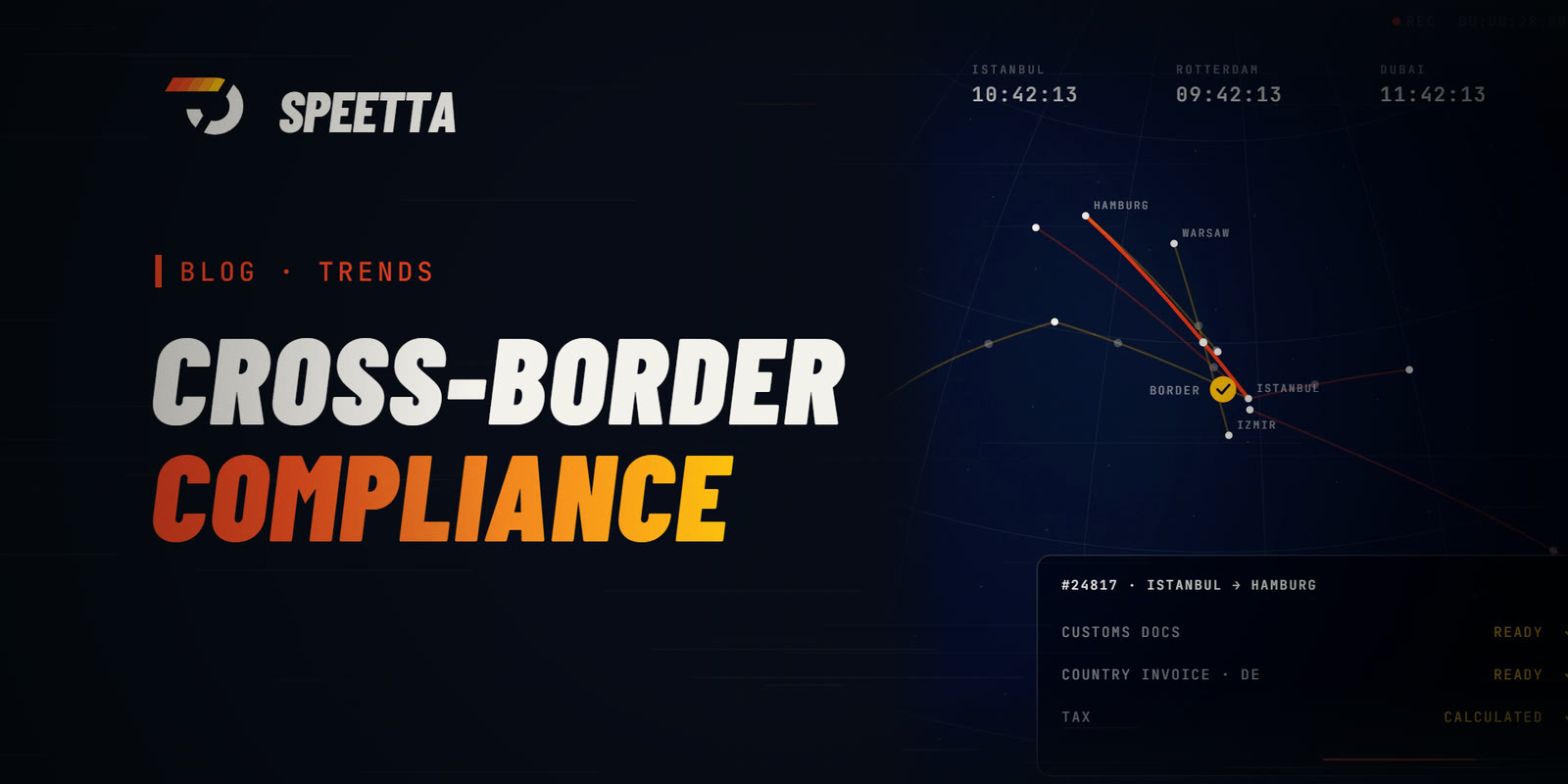
- Country-specific tax, customs and regulatory document automation
- Automatic, accurate invoice generation per legal requirement
- Document management with automatic alerts for expiring permits and inspections
- Border-rule integration for compliant international routing
This approach doesn't just prevent errors; it adds speed. When documents are accurate and complete, the shipment doesn't wait at the border, and that flows straight through to delivery time.
Compliance is not a cost — it's a speed lever
Most companies see compliance as a cost and a burden. Done right, it's the opposite: compliance is the key to cross-border speed. A shipment that doesn't get stuck at customs is delivered days ahead of a competitor's. That's why compliance automation should be thought of less as a "risk-reduction" project and more as a "competitive-advantage" one.
Why is this critical now?
Two forces are accelerating the shift. First, cross-border volumes are rising as e-commerce globalizes — even small businesses now ship internationally. Second, regulatory complexity is growing: sustainability claims, digital product passports and tightening customs rules increasingly require product data to be evidence-backed and consistent. At the intersection of these two forces, hand-managed compliance becomes unsustainable.
Compliance isn't a box checked after the shipment leaves — it's a rule applied as the shipment is created.
The rising bar: from paperwork to provable data
There's a deeper shift underneath the customs paperwork. Regulators are moving from accepting declarations to requiring evidence. Digital product passports, origin traceability and sustainability reporting all point the same way: the data attached to a shipment must now be consistent, connected and auditable — not just present. A country-of-origin claim, a materials declaration, a carbon figure: each is increasingly something you may have to prove, not just state. This raises the bar for cross-border operations in a way that manual processes simply can't meet, because a spreadsheet can hold a number but can't guarantee where that number came from or whether it matches the other systems. The operations that will move fastest across borders in the coming years are the ones whose data is already unified and traceable — which is exactly what embedding compliance in the software delivers as a by-product.
The paradox of scaling across borders
Cross-border expansion has a counterintuitive property: the complexity doesn't grow linearly with volume, it grows with the number of countries. Doubling shipments to one market you already serve is mostly a capacity question. Adding one new country, even at low volume, means a whole new set of customs rules, tax rates, document formats and edge cases. This is why manual compliance breaks precisely when a business is expanding fastest — the moment growth is most valuable, the manual burden is compounding hardest. Embedded compliance changes the shape of that curve. Once the rules for a country live in the software, adding volume there is nearly free, and adding a new country becomes a configuration task rather than a hiring one. In effect, automating compliance is what lets a logistics operation expand its geography without expanding its back office at the same rate — the difference between growth that scales and growth that strangles.
The real cost of a border delay
The headline cost of a customs hold is the storage and demurrage fees, but those are rarely the largest part. A shipment stuck at the border sets off a chain: the customer waits and loses trust, the sale may be refunded, the vehicle and driver are tied up instead of earning on the next job, and your planning team spends hours chasing paperwork instead of moving freight. For time-sensitive goods, a delay can destroy the value of the shipment entirely — perishables spoil, seasonal stock misses its window, a promised launch date slips. This is why compliance automation returns more than it appears to on paper: you're not just avoiding a fine, you're protecting the entire downstream value of every cross-border order. The fee is visible; the cascade behind it is where the real money is.
Where to start?
Start with the cross-border corridor you use most. Map that corridor's document, tax and customs requirements and automate those first. Automating the most-repeated process delivers the biggest and fastest gain. Let's look at how to automate compliance in your cross-border operation in a demo.