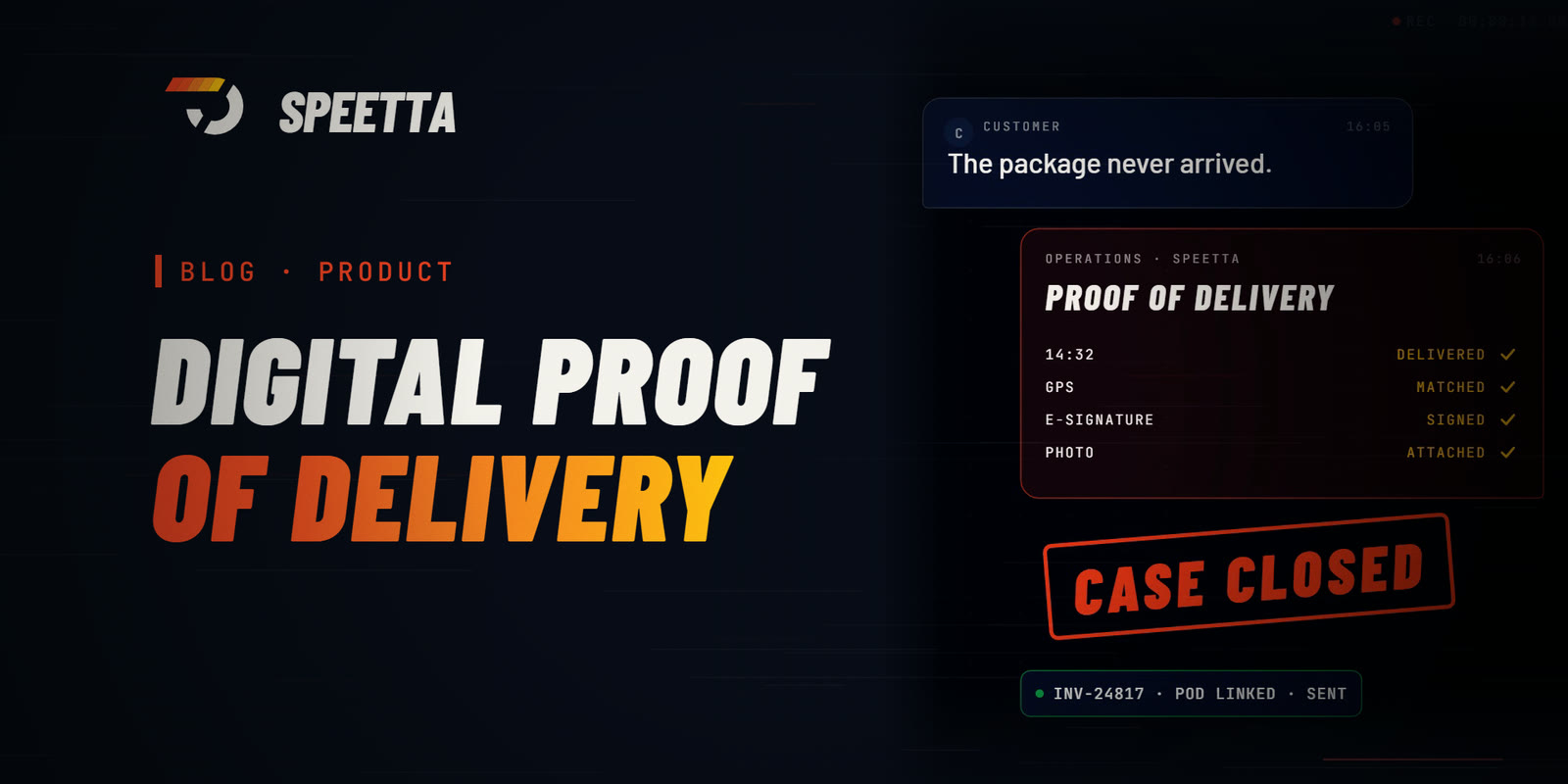
Proving a delivery happened seems simple — until a customer says "the parcel never arrived." In a paper-receipt process, that dispute takes hours, sometimes never resolves, and almost always ends in lost trust. Digital proof of delivery (POD) removes that uncertainty — and while doing so creates value in an unexpected place: cash flow.
The four hidden costs of paper POD
- Lost evidence: Physical receipts get lost; you're left with no data in a delivery dispute, and usually lose the dispute.
- Illegible signature: Who received it, when, where — unclear. A signature that isn't evidence is worthless.
- Delayed collection: An unprovable delivery delays payment; the customer says "prove it first," you go looking for paper.
- Manual reconciliation: Matching each receipt by hand is an invisible workload that eats hours at day's end.
What digital POD changes
In Speetta, every delivery is tied to digital evidence in the field, instantly:
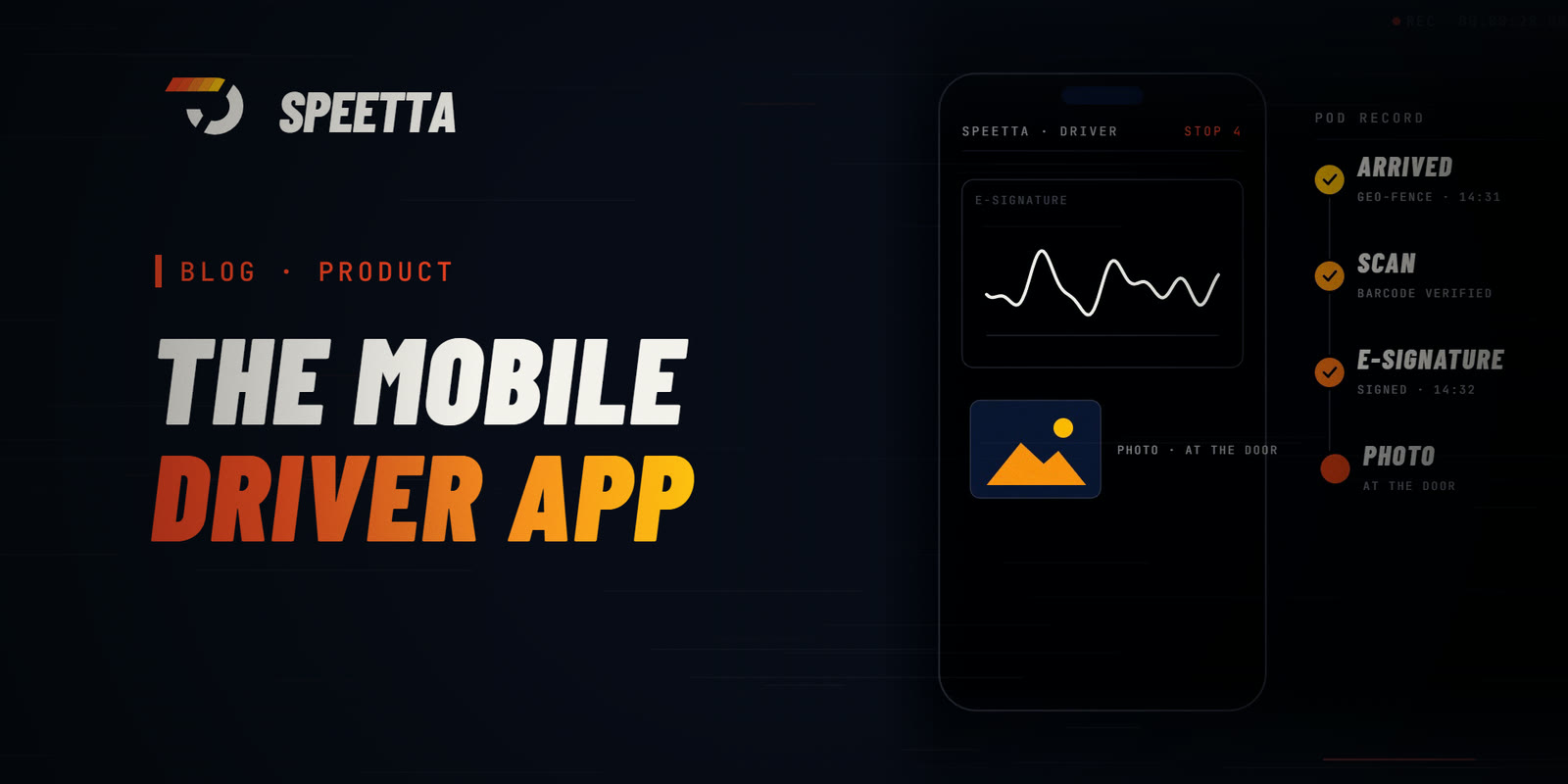
- E-signature: The recipient's signature is recorded with a time and location stamp.
- Barcode scan: It's verified that the right parcel reached the right address; wrong delivery is caught at the source.
- Photo: The delivery and — if needed — any damage is documented on the spot; later disputes are met with evidence.
- Real-time flow: Evidence reaches the center instantly; the customer is notified automatically.
POD isn't just a record — it's a cash-flow tool
Here's what most operations miss: digital POD is not an archiving feature but a finance tool. Proven delivery speeds up invoicing because the "was it delivered?" question no longer exists. It prevents disputes because the evidence is timestamped and indisputable. And it shortens the collection cycle because payment is tied to proof of delivery. That direct link between delivery and invoice has a surprising effect on working capital.
POD is also the foundation of customer trust
Beyond the financial impact, digital POD is a trust mechanism. When a customer gets an automatic notification at the moment of delivery, and can see the delivery with a photo and timestamp, their trust in the brand grows. Transparency is the strongest loyalty tool, and POD is its most concrete form.
A delivery you can't prove counts as one that never happened. Digital POD zeroes out that risk.
The working-capital angle few operations calculate
Here's a number most logistics teams never put on paper: the cost of the gap between delivery and payment. In a paper process, an invoice often can't go out until the signed receipt is back at the office and matched — days later. Every day in that gap is working capital tied up in deliveries you've already completed. Multiply an average delay of a few days across a year of shipments and the amount of cash frozen at any moment becomes significant. Digital POD collapses that gap to near zero: the moment the driver confirms delivery in the field, the proof is in the system and the invoice can go out the same day. This is why treating POD as a mere compliance record misses its biggest value. It isn't primarily about winning disputes — those are the exception. It's about turning completed deliveries into cash faster, on every single order, which is the rule.
Matching the proof to the delivery
Not every delivery needs the same level of proof, and a well-designed POD flow reflects that. A high-value or disputed-prone shipment might warrant a signature plus a photo plus a barcode scan; a routine parcel drop might need only a scan and a geotag. Forcing heavy proof on every delivery slows drivers down and hurts adoption; requiring too little leaves you exposed exactly where it matters. The right approach is to tier proof requirements by risk — value, customer history, delivery type — so the flow stays fast where it can and rigorous where it must. This is where digital POD outclasses paper decisively: a paper process applies one clumsy standard to everything, while a configurable digital flow adapts the evidence to the stakes, delivering both speed and protection instead of trading one for the other.
POD as a source of operational truth
There's a third value beyond dispute resolution and cash flow, and it's the one that compounds. Every digital POD is a precise data point: exactly when a delivery completed, where, and by whom. Collected across thousands of deliveries, this becomes a record of how your operation actually performs versus how you assume it does. It reveals which zones run consistently late, which time windows have the highest failure rates, which drivers or carriers deliver reliably, and where the gap between promised and actual ETA is widest. None of this is visible in a paper process — the receipts are filed and forgotten. Digital POD turns the moment of delivery from a dead end into the start of a feedback loop, feeding the same analytics that drive routing and forecasting. In this sense POD isn't the last step of a delivery; it's the first step of the next improvement.
Where to start?
Start with the customer or region where you have the most delivery disputes — digital POD's value shows up instantly there. Driver adoption is critical: the faster and simpler the confirmation flow (one-tap barcode, one-tap photo), the higher the adoption. See Speetta's digital POD flow in a demo and watch delivery disputes get resolved in seconds.