Dispatch assignment is the decision at the heart of a logistics operation: which shipment goes to which vehicle or carrier, on which route? At low volume this can be done by hand, and a good dispatcher does surprisingly well. But as shipments and carriers grow, manual assignment becomes a bottleneck — even a single-person dependency risk.
The mathematical limit of manual assignment
A human can't weigh every carrier option, cost, capacity and delivery window for each shipment at once. Five carriers and fifty shipments create a combination space the human mind can't solve by intuition. The result is predictable: the cheapest or fastest option is often missed, vehicles go half-empty, and 3PL coordination becomes endless phone traffic.
How AI automates assignment
- Smart load planning: Shipments are assigned optimally to one vehicle by weight, volume and destination; utilization is maximized.
- Carrier selection: A balance is struck automatically between your own fleet and 3PLs by cost, availability and past performance.
- Route-based dispatch: Assignment happens in sync with the optimized route; empty returns and unnecessary trips drop.
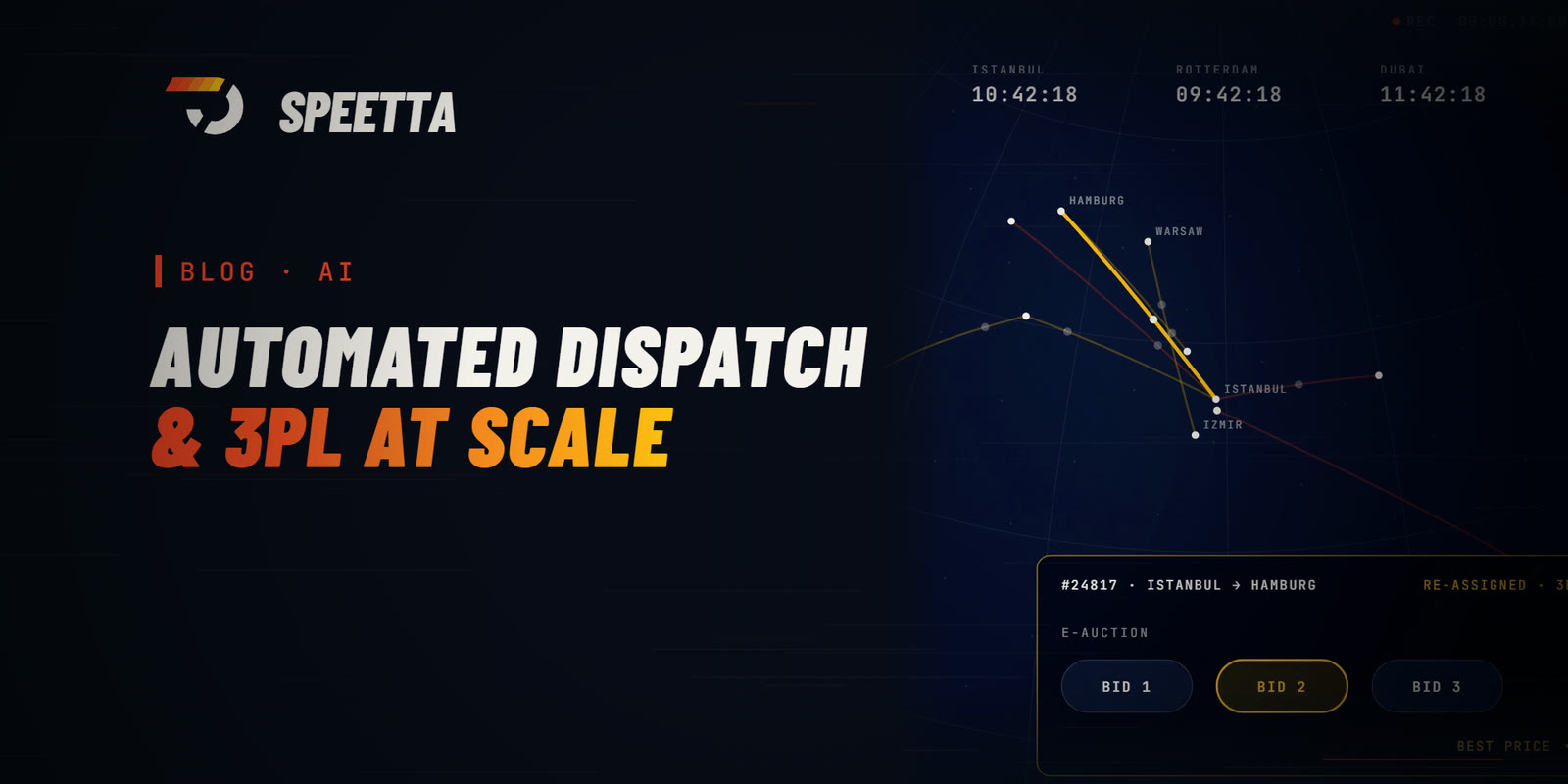
- e-Auction: Vehicle owners bid for deliveries; price is optimized by market dynamics.
- Performance analytics: Driver and vehicle performance is measured continuously; assignment gets smarter over time and learns poor performers.
Automation turns 3PL from a black box into a partner
In a manual process, each 3PL carrier is a separate black box: you don't know its performance, can't compare its cost, and chase it by phone when a problem arises. Automated assignment makes all carriers visible and measurable on one platform. Now each carrier is a comparable resource by performance and cost. That also changes your negotiating power: when you know with data which carrier is genuinely good, you renew contracts with data.
Why is this a Gartner 2026 priority?
Gartner's 2026 TMS research points to AI and AI agents automating "routine tasks such as appointment scheduling, exception handling and freight procurement" as one of the market's defining trends. Dispatch assignment falls squarely into that category: a high-frequency, rule-based yet complex decision. Gartner also notes that "GenAI and agentic AI" are driving differentiation in TMS — meaning automated assignment is no longer a "future feature" but today's competitive standard.
Manual assignment works at human speed. Automated assignment works at operation speed.
The dispatcher's new job
A fair worry about automating dispatch is that it replaces experienced people. In practice it changes their job rather than removing it — and usually for the better. When the system handles the high-volume, standard assignments, the dispatcher stops spending the day on repetitive matching and starts managing what machines handle poorly: the genuine exceptions, the sensitive customer, the carrier relationship, the judgment call when two priorities conflict. This is the same pattern Gartner describes when it frames AI agents as automating "routine tasks" — the emphasis is on routine. The highest-performing operations treat automation and human judgment as a division of labor, not a competition: the machine covers breadth and speed, the human covers depth and exceptions. An operation that automates dispatch but keeps its best dispatchers, now focused on the hard 10%, ends up stronger than one that does either alone.
When the market sets the price
One of the most underused features of automated dispatch is the e-auction. In a manual world, carrier rates are set by relationship and habit — you use the carrier you always use, at the rate you negotiated last year, whether or not it's competitive today. An e-auction flips this: for each delivery or lane, available carriers bid, and price is set by real-time supply and demand rather than inertia. For standard, non-time-critical shipments, this consistently surfaces capacity you didn't know was available at rates you wouldn't have negotiated. It also keeps your incumbent carriers honest, because they now compete for volume rather than assume it. The point isn't to squeeze partners on every load — long-term relationships still matter for reliability — but to know the true market rate, so every decision to pay above it is a deliberate choice rather than a blind default.
The single-dispatcher risk
In many growing operations, dispatch quietly becomes a single point of failure. One experienced person holds the mental map of which carrier is reliable, which route is tricky, which customer needs special handling. It works — until that person is sick, on leave, or leaves the company, and suddenly the operation slows to a crawl because the knowledge walked out the door. Automating dispatch isn't just about speed at high volume; it's about turning that fragile, person-bound knowledge into a durable system asset. The rules, the performance history, the carrier scores — all of it lives in the platform rather than one head. Paradoxically, this makes the human dispatcher more valuable, not less: freed from being the operation's memory, they become its strategist. Resilience, not just efficiency, is a core reason to automate.
Where to start?
Start with your most repeated, most standard shipment type — that's where automation's gain is clearest and fastest. Leave complex, exceptional shipments to humans first; expand the scope as the system learns. A good automated assignment system doesn't remove people from the decision; it frees them from routine decisions to focus on exceptions. See Speetta's automated dispatch and 3PL integration in a demo.