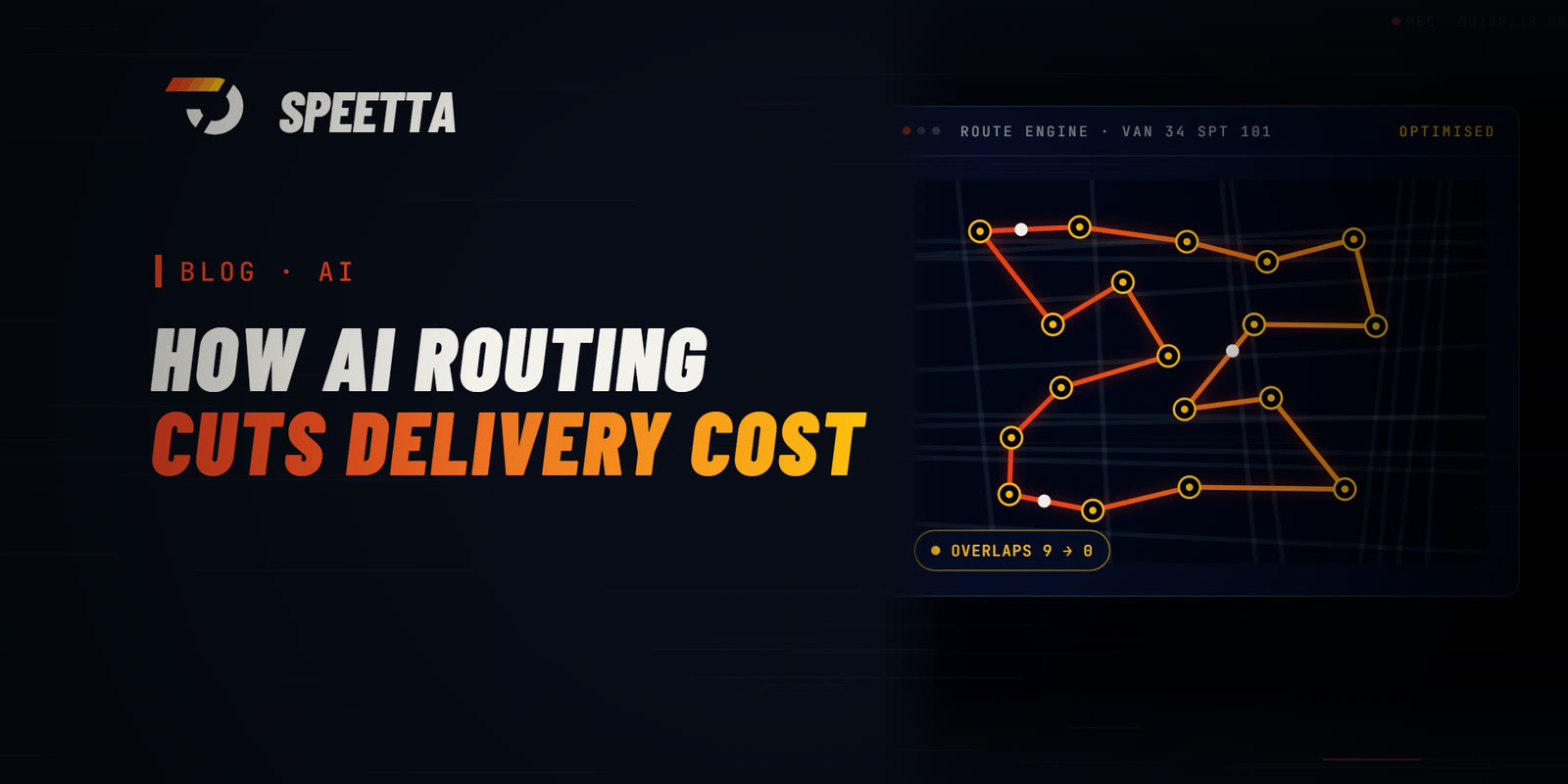
"Route optimization" is often assumed to mean the shortest distance between two points. In reality the problem is far more complex: dozens of stops, different delivery windows, variable traffic, vehicle capacity and cost constraints must be solved at once. In mathematics this is the "vehicle routing problem," and as stops increase the possible combinations grow astronomically. A human mind can't solve this at scale; a well-designed AI can.
The hidden cost of static planning
Routes planned by hand or with fixed rules lose money in three places. First, unnecessary mileage: every unoptimized route is a direct cost in fuel and vehicle wear. Second, idle driver time: inefficient sequencing, waiting and backtracking burn driver hours. Third, low vehicle utilization: every half-empty trip splits fixed cost across fewer parcels.
Each of these looks small on its own — five minutes on one route, 10% empty space in one vehicle. But across a fleet, over hundreds of shipments, it quietly erodes margin. The most dangerous thing about these losses is that they're invisible: no one sees them as a line item.
What machine learning does differently
Speetta's routing engine learns from historical delivery data and recalculates every plan against real conditions. Unlike a static rule set, it improves over time:
- Dynamic re-routing: When traffic, a new order or a delay changes, the route updates instantly. The plan runs on the current reality, not the morning's forecast.
- Multi-stop consolidation: Different shipments are combined into a single trip by weight, volume and destination — raising value per trip, not just trip count.
- Load balancing: Vehicles are filled to optimal capacity; half-empty trips shrink and the fleet does more work with fewer vehicles.
- Cost-speed trade-off: The best carrier and mode are chosen per route not just by distance, but by cost, delivery window and service level.
AI is only as good as the data beneath it
Here we reach 2026's most common mistake: treating AI as a magic box. The truth is that a model is only as good as the data it's fed. If shipment history, address quality, vehicle capacities and delivery windows are inconsistent or incomplete, the model produces confidently wrong routes. That's why the real gain comes from the data before the algorithm.
Gartner's positioning of predictive analytics as a defining trend in its 2026 TMS research reflects the same truth: analytics only creates value when it runs on clean, connected data. A TMS's real job is to provide that clean data layer — to build the ground the AI stands on.
Results become numbers
When the right data and the right engine come together, the impact becomes measurable. Companies using Speetta see up to 30% lower delivery costs and up to 40% faster deliveries. That's the sum of three things: less fuel, higher vehicle utilization, and the largely eliminated burden of manual planning.
But perhaps the most valuable gain is the invisible one: the planning team's time. A team that manages exceptions, supplier relationships and growth instead of drawing routes by hand is a competitive advantage in itself.
The value of AI isn't in looking "smart" — it's in delivering measurable cost reduction on every shipment.
Three myths that quietly cost money
Three common beliefs keep operations from capturing the full value of routing. The first is that "our routes are already efficient because our drivers know the area." Driver knowledge is real and valuable, but it's local and static — it can't weigh forty stops, live traffic and cost trade-offs simultaneously, and it walks out the door when the driver leaves. The second myth is that "optimization only matters for large fleets." In fact, smaller fleets often have less slack to absorb inefficiency, so the percentage impact can be larger. The third is that "once we set it up, we're done." Routing is not a project with an end date; conditions change weekly, and a system that stops learning stops saving.
A concrete example
Consider a mid-sized distributor running twelve vehicles across a metro area with roughly 300 daily deliveries. Under manual planning, routes are drawn the night before and don't adapt to morning traffic or same-day orders. Two hidden costs dominate: vehicles run 15–20% more kilometers than necessary, and each vehicle averages 70% utilization. Dynamic routing addresses both at once — trimming distance and raising utilization — which is exactly why the combined effect lands in the 30% cost-reduction range rather than a marginal single-digit improvement. The point isn't the specific numbers; it's that the two levers compound.
What optimization can't fix
Honesty about limits builds more trust than overpromising. Route optimization is powerful, but it can't compensate for problems that live upstream of routing. If your addresses are dirty, the best algorithm still sends a driver to the wrong street. If your delivery promises are unrealistic, no route can keep them. And if demand swings wildly with no forecast, optimization is always reacting rather than planning. Recognizing this reframes optimization correctly: it's not a silver bullet, it's the highest-leverage layer in a stack that also needs clean data, honest promises and demand foresight beneath it. The operations that get the full 30% aren't the ones with the fanciest algorithm — they're the ones that fixed the fundamentals first, then let optimization compound on top.
Where to start?
Moving to route optimization isn't an all-or-nothing decision. Start with your highest-volume, highest-cost delivery zone; measure the gain there and expand. The key is collecting the right data from day one: each shipment's real departure and arrival time, real cost and real delivery outcome. That data determines how much the model improves over time.
Book a demo to see how much route optimization would save in your own operation — let's talk numbers with your data.