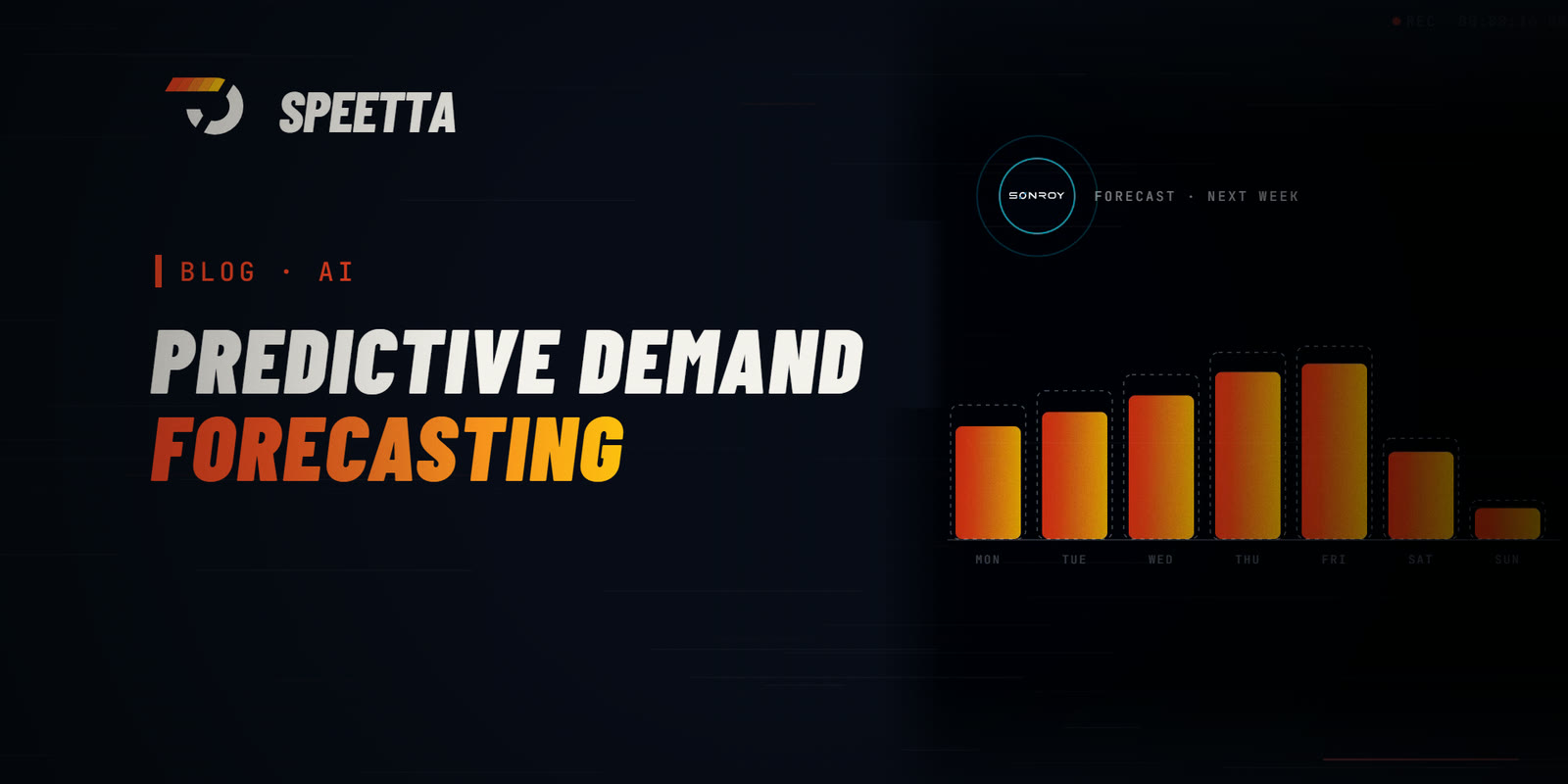
Being reactive is expensive in logistics. Arranging a vehicle after the order lands, finding a last-minute carrier and setting up rush shipments is slow and costly — because urgency always commands a premium. Predictive demand forecasting flips the equation: it sees demand before it exists and positions resources accordingly, in advance.
Why forecasting is a logistics problem
Demand fluctuation is usually assumed to be the sales team's job. Yet the bill for a wrong forecast is most often paid by logistics: idle vehicles, insufficient capacity and expensive shipments made in a panic. A right forecast positions resources at the right time, in the right place — vehicle, driver and stock ready before demand arrives.
This turns logistics from a cost center into a planning advantage. An operation that can forecast demand 10% more accurately a week ahead uses that week to balance capacity, negotiate cheaper carrier contracts and avoid rush shipments.
How AI forecasts
Modern forecasting is far more than averaging the past. The AI forecasting in Speetta's control tower combines several signals:
- Historical patterns: The model learns from past shipment volume, seasonality and weekly fluctuations.
- Real-time signals: Current order flow, stock levels and channel data are evaluated live; the forecast is dynamic, not static.
- Capacity planning: Vehicle and driver capacity is set in advance against expected demand; bottlenecks are seen before they form.
- Cost optimization: Foresight turns expensive rush shipments into planned, cheap ones.
The hidden value of foresight: the trip you never make
When route optimization comes up, people usually think "a better route." But the best route is the trip foresight means you never had to make. An operation that reads demand correctly consolidates unnecessary shipments, prevents half-empty trips and eliminates most emergency transport. It means the most expensive mile is the mile never driven.
Forecasting depends on the data beneath it
Here we reach the shared truth of all AI applications: the model is only as good as the data it's fed. As long as shipment, stock and delivery data sit in disconnected systems, forecasting stays weak — because the model sees only part of the picture. That's why foresight only produces real value on consistent data unified in a single platform.
Gartner's positioning of predictive analytics as a defining trend in its 2026 TMS research confirms this dependency: analytics gets its value not from the algorithm but from the data layer it's built on. This is precisely a TMS's strategic role: to provide the clean, connected data AI needs to forecast reliably.
Where to start?
You don't need perfect data to move to predictive forecasting; you just need to start collecting consistent data. Begin with your most volatile, hardest-to-predict product group or region — that's where the improvement potential is greatest. Feed the model your shipment history, compare its forecasts against actuals, and measure its confidence over time. Forecast accuracy improves not overnight, but a little more each cycle.
The best-optimized trip is the one foresight means you never had to make.
Forecasting connects sales and logistics
One of the quiet benefits of shared forecasting is organizational, not technical. In many companies, sales and logistics operate on different numbers: sales forecasts revenue, logistics guesses at volume, and the two only meet when something goes wrong. A demand forecast built into the logistics platform gives both sides one shared, living number to plan against. Sales sees the operational consequence of a promotion before launching it; logistics sees the demand signal early enough to secure capacity at a normal rate instead of a rush premium. The forecast stops being a report someone files and becomes a conversation both teams have with the same data. That alignment often saves more than the algorithm itself, because it prevents the most expensive failures — the ones caused not by a wrong model but by two teams planning against different assumptions.
How to judge a forecast honestly
A forecast is only useful if you know how wrong it tends to be. Two operations can both "use AI forecasting" while one drives real savings and the other quietly wastes capacity — the difference is measurement discipline. Track forecast accuracy the way you'd track any other metric: compare predicted demand against actuals, by region and product group, every cycle. Watch for two failure modes. Systematic bias means the model is consistently high or low — usually a data problem, not a model problem, and fixable. High variance means the model is right on average but unreliable on any given day, which is worse for planning because you can't act on an average. A good forecasting system exposes both numbers plainly; be wary of any that shows only a confident single figure with no error band.
Where to start?
You don't need perfect data to move to predictive forecasting; you just need to start collecting consistent data. Begin with your most volatile, hardest-to-predict product group or region — that's where the potential is greatest. Feed the model your history, compare its forecasts against actuals, and measure its confidence over time. Accuracy improves not overnight, but a little more each cycle.
See how the AI forecasting in Speetta's control tower fits your operation — with your own data, in a demo.