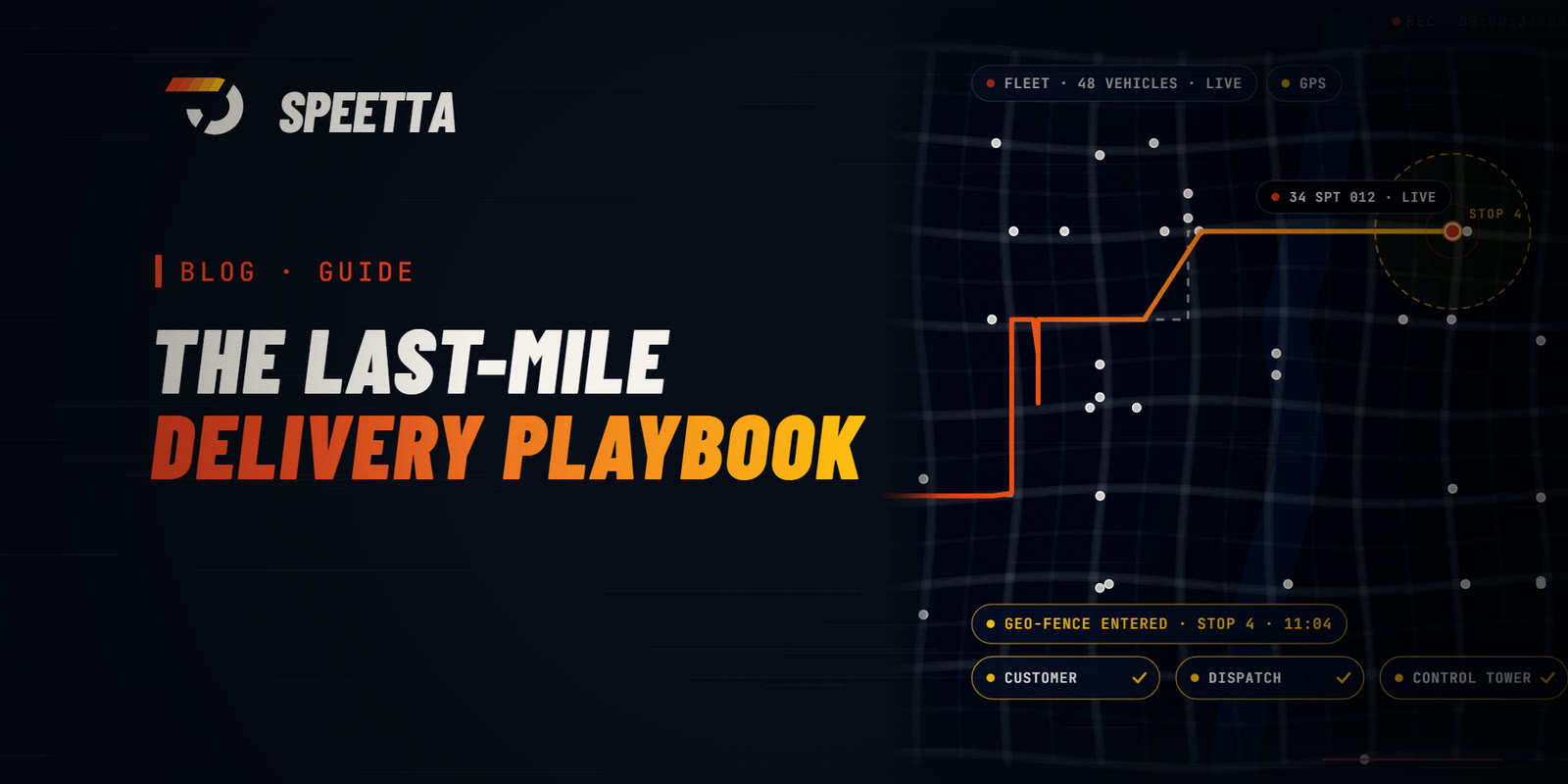
The last mile makes up a large share of an order's total logistics cost and is the final moment the customer touches the brand. Industry analyses show the last mile consumes close to half of total delivery cost in most operations. A mistake here overshadows all the good work across the supply chain; a successful delivery, by contrast, is one of the strongest moments of customer loyalty. The good news: the last mile holds the most room for improvement.
This playbook walks through five practices that turn the last mile from a cost center into a competitive advantage. Each creates value on its own; applied together, the impact compounds.
1. Keep the delivery window realistic and narrow
Wide, vague time slots ("sometime today") keep customers waiting and raise failed-delivery rates — because the customer may not be home during those hours. Every failed delivery is a fresh trip cost from scratch. An AI-calculated realistic ETA both manages expectations and lowers re-delivery cost.
The insight here is that a narrow window isn't only a customer-experience nicety — it's a direct cost lever. A narrow, accurate window raises the first-attempt delivery rate, the single most critical metric in last-mile economics.
2. Equip the driver with live information
Drivers should receive dynamic route updates and delivery instructions from a mobile app. Paper manifests and phone coordination are slow and error-prone. If a driver waits in the field while the center tries to redirect them by phone, those minutes are both fuel and a missed delivery.
A mobile driver app connects the field to the center in real time: a route change lands on the driver's screen instantly, the delivery sequence is optimized, and every stop is recorded centrally. This directly increases deliveries per driver per day.
3. Communicate proactively
Send shipment status to the customer automatically via SMS, email or app notification. "Where is it?" calls tie up customer service, lower satisfaction, and are entirely preventable. If a customer knows their parcel is on the way and when it will arrive, they don't call.
The second-order effect of proactive communication is often overlooked: every prevented "where is it?" call gives capacity back to the customer service team. Visibility doesn't just please the customer; it reduces operational load.
4. Digitize proof of delivery
Digital proof of delivery (POD) with e-signature, barcode scan or photo prevents disputes and speeds up collection. Paper receipts get lost; digital records stay, proving with a timestamp who received the parcel, where and when. The "it never arrived" dispute is resolved in seconds with digital POD.
POD isn't just a record — it's a cash-flow tool: proven delivery speeds up invoicing and eliminates payment disputes.
5. Manage failed deliveries as an exception flow
Handle undeliverable shipments with automated return logistics and exception reports. Failed deliveries tracked by hand turn into lost parcels — and every lost parcel is both product cost and a new trip cost. A flow that systematically captures exceptions closes this leak.
The anatomy of a failed delivery
To see why the last mile is so expensive, follow the cost of a single failed delivery. The vehicle drives to the address (fuel, driver time). No one is home. The parcel returns to the depot (handling, storage). It's rescheduled (planning time). It's driven out again the next day (a second full trip). If that attempt also fails, the parcel may be returned to sender entirely (reverse logistics, lost sale, refund). One failed delivery can cost two to three times a successful one — and none of that appears as a distinct line item. This is why the first-attempt delivery rate is the single most leveraged number in last-mile economics: every point of improvement removes an entire chain of hidden cost.
No improvement without measurement
All five practices rest on one foundation: measurement. First-attempt delivery rate, deliveries per driver, failed-delivery rate and cost per delivery — these four metrics are the last mile's health dashboard. That Gartner tracks real-time transportation visibility as its own market category shows exactly how strategic this measurement need has become. You can't manage what you can't see; you can't improve what you don't measure.
Winning the last mile doesn't come from heroics — it comes from a system that makes every delivery visible, automated and measurable.
The last mile is your brand's last impression
There's a strategic reason to invest here that goes beyond cost. For most e-commerce and retail brands, the delivery is the only physical, in-person moment the customer has with the company. Everything else — the website, the ads, the packaging design — is preparation; the delivery is the payoff. A late, uncertain or failed delivery doesn't just cost a re-run; it undoes the brand impression the rest of the business worked to build. Conversely, a delivery that arrives when promised, with proactive updates and a clean handoff, is a quiet act of trust that no marketing budget can buy. This is why treating the last mile purely as a logistics cost center misreads it. It's simultaneously your largest controllable cost and your most frequent brand touchpoint — which means every improvement here pays twice.
Where to start?
Start with your zone that has the highest failed-delivery rate — that's where the improvement potential is greatest. Measure first: what's your first-attempt delivery rate? Then focus on a single lever (say, a narrower delivery window) and measure its effect. Small, measurable steps always outlast a big but vague transformation.
Speetta's mobile app, control tower and digital POD manage the last mile end to end. See how it works in your own delivery flow in a demo.